Handcrafted vs Machine-Made Jewellery: What You’re Actually Paying For?
March 16, 2026
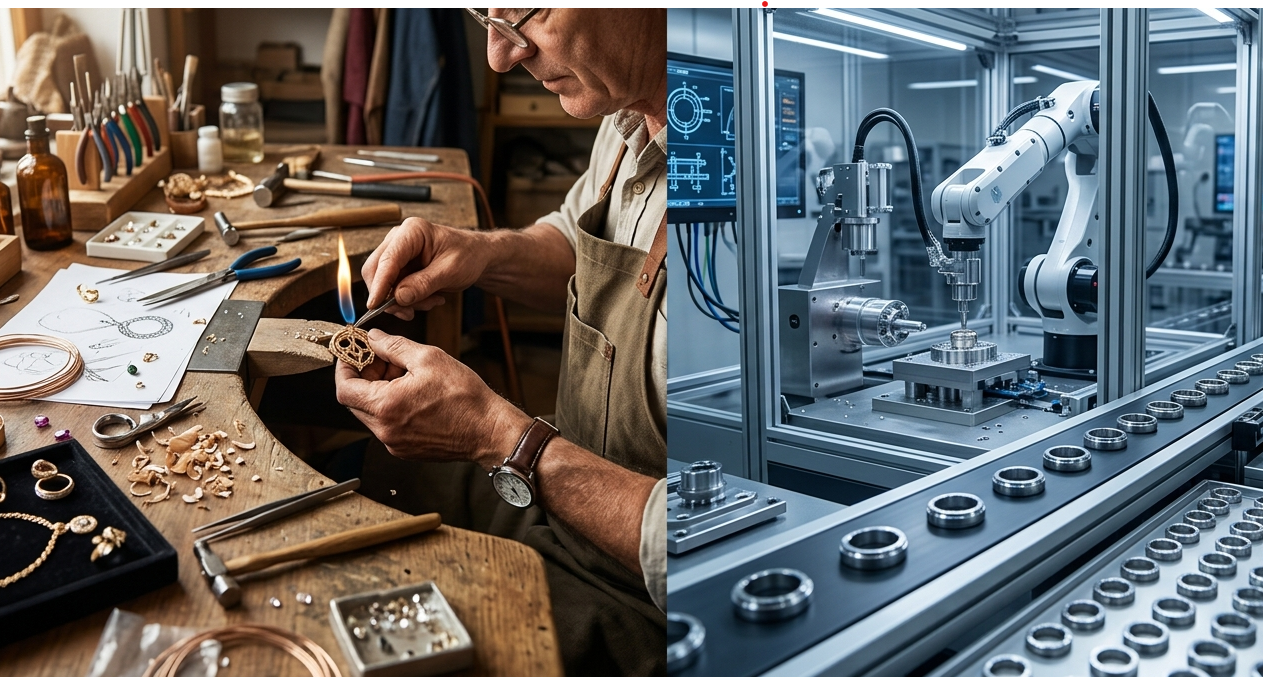
When shopping for jewellery, many buyers naturally focus on gold weight, gemstone size, or overall price. But there is another important factor that often goes unnoticed—how the jewellery was made.
Two pieces of jewellery may look similar at first glance, yet their prices can vary significantly. One of the most common reasons for this difference is whether the piece is handcrafted by artisans or produced using machines.
Both methods play important roles in modern jewellery production. But understanding the difference helps consumers appreciate what they are truly paying for.
The Human Touch Behind Handcrafted Jewellery
Handcrafted jewellery is created by skilled artisans who shape, assemble, and finish each piece manually. These craftsmen often spend years mastering traditional techniques that have been passed down through generations.
Handmade jewellery may involve processes such as:
- Detailed metal shaping
- Hand engraving
- Stone setting by hand
- Filigree or wire work
- Traditional enamelling techniques
Because each step requires precision and patience, handcrafted jewellery can take many hours—or even several days—to complete.
This labour-intensive process is one of the reasons handcrafted pieces often carry higher making charges.
However, what buyers receive in return is not just jewellery—it is a piece of wearable art.
Why Handcrafted Jewellery Often Feels Unique
One of the defining characteristics of handmade jewellery is individuality.
Since every piece is shaped and finished by hand, subtle variations occur naturally. These small differences make each creation feel personal and distinctive, rather than identical to hundreds of others.
For consumers who value artistry and craftsmanship, handcrafted jewellery often holds greater emotional and aesthetic value.
In many cultures, including India’s rich jewellery heritage, handcrafted work is also closely linked with regional traditions and artisan communities.
The Precision of Machine-Made Jewellery
Machine-made jewellery is produced using advanced manufacturing technologies such as:
- Computer-aided design (CAD)
- Automated casting systems
- Laser cutting and engraving
- Precision stone-setting machines
These technologies allow manufacturers to produce jewellery with high consistency and uniformity.
Machine production also enables large-scale manufacturing, which can help reduce costs for consumers.
Because machines can replicate the same design repeatedly with minimal variation, machine-made jewellery is often more affordable and widely available.
Design Complexity: Where Technology Shines
Modern jewellery design has evolved significantly thanks to technology.
Computer modelling allows designers to experiment with:
- Highly intricate patterns
- Structural engineering for durability
- Lightweight yet visually complex designs
Many contemporary jewellery styles that appear delicate and detailed are made possible through advanced machine-assisted processes.
This means machine-made jewellery is not necessarily “simpler”—in many cases, it is technologically sophisticated.
Craftsmanship vs Efficiency
The key difference between handcrafted and machine-made jewellery lies in time and human involvement.
Handcrafted jewellery prioritizes:
- Artisan skill
- Traditional techniques
- Unique finishing touches
Machine-made jewellery prioritizes:
- Precision
- Speed of production
- Design consistency
Both approaches have their advantages, and many modern jewellery pieces actually combine machine precision with final hand-finishing by artisans.
Durability and Quality
Consumers sometimes assume that handmade jewellery is automatically stronger or that machine-made jewellery is always superior in precision.
In reality, quality depends on the manufacturer and the design, not just the method of production.
Well-made handcrafted jewellery can be extremely durable due to careful manual construction. Meanwhile, machine-made jewellery can achieve remarkable precision that ensures consistent structural strength.
The most reputable jewellers carefully balance technology and craftsmanship to produce jewellery that is both beautiful and long-lasting.
Understanding the Price Difference
When handcrafted jewellery costs more, the price usually reflects:
- Skilled artisan labour
- Time-intensive production
- Specialized traditional techniques
- Unique finishing work
Machine-made jewellery may cost less because:
- Production is faster
- Designs can be replicated at scale
- Labour costs are lower
However, both types of jewellery can offer excellent value depending on what the buyer prioritizes.
What Should Jewellery Buyers Look For?
Rather than focusing solely on whether jewellery is handmade or machine-produced, buyers should consider:
- Craftsmanship quality
- Comfort and wearability
- Design originality
- Long-term durability
- Personal style preferences
Ultimately, the best piece of jewellery is one that combines beauty, craftsmanship, and meaning for the wearer.
When you buy jewellery, you are not just paying for metal and gemstones.
You are also paying for the creativity, skill, and technology that bring the design to life.
Related articles

Where luxury finds meaning.